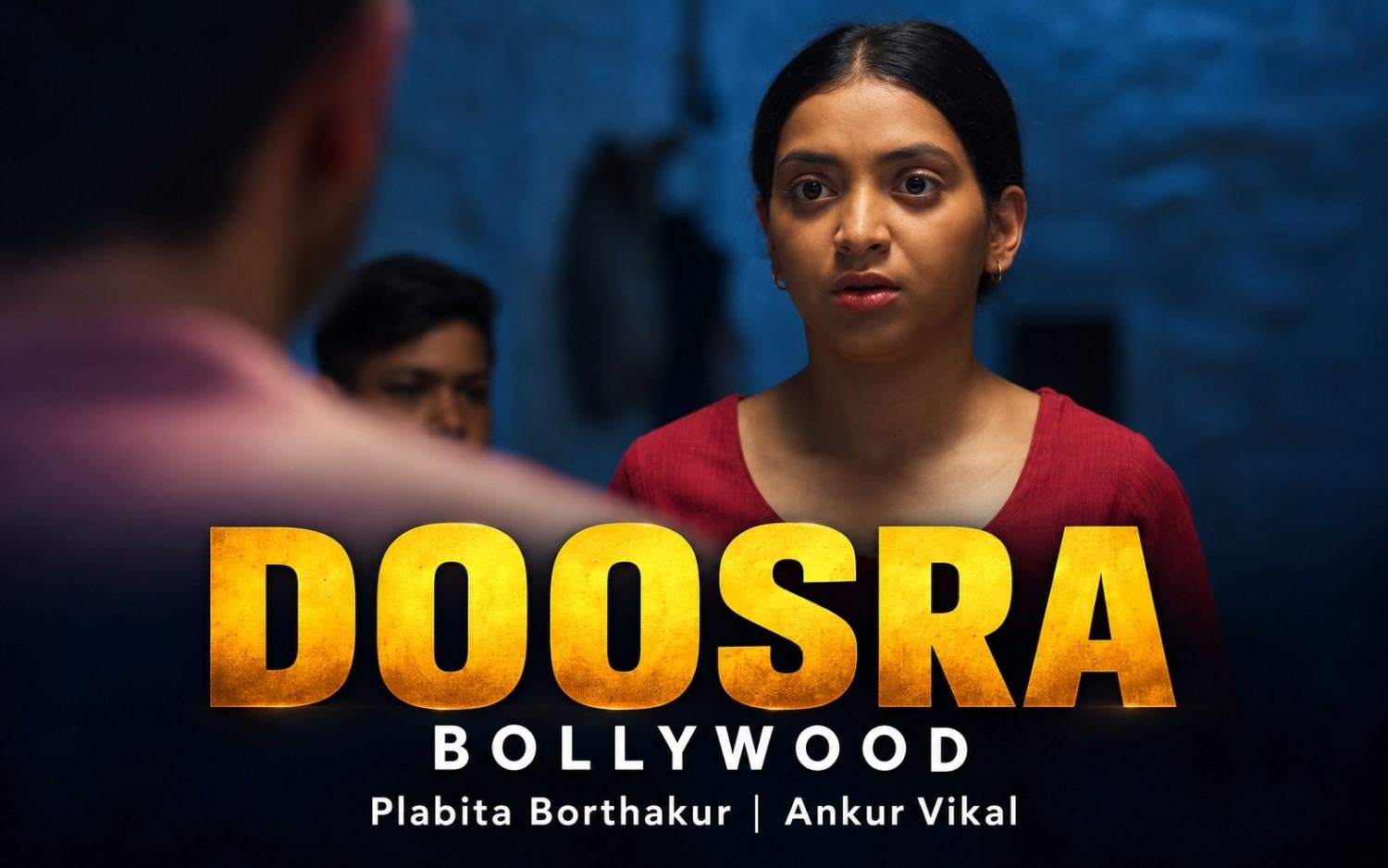
DOOSRA – Bollywood | Plabita Borthakur | Ankur Vikal
Movie Details
| Category | Details |
|---|---|
| Movie Name | Doosra |
| Director | Abhinay Deo |
| Lead Cast | Plabita Borthakur, Ankur Vikal |
| Supporting Cast | Samidha Guru, Tvisha Seema, Krishna Gokani, Rajeev Ankit, Mohammad Iliyas, Kusum Gupta |
| Genre | Sports Drama, Social Drama |
| Language | Hindi |
| Release Date | October 23, 2026 |
| OTT Platform | To be announced |
| Running Time | Approximately 2 hours |
| Rating | ⭐⭐⭐⭐/5 |
DOOSRA – Bollywood | Plabita Borthakur | Ankur Vikal
Introduction & Overview
Doosra is an ambitious Bollywood sports drama that attempts to tell a cricket story from an unusual perspective. Directed by Abhinay Deo, the film connects the cultural impact of Indian cricket with the personal journey of a young woman growing up inside a restrictive social environment.
At the centre of the narrative is Tara, played by Plabita Borthakur, whose personal struggle develops alongside one of the most memorable periods in Indian cricket. Rather than functioning as a conventional cricket film packed with match sequences, Doosra uses cricket as a metaphor for confidence, independence and the desire to challenge established expectations.
The film takes inspiration from India’s famous 2002 NatWest final victory over England, particularly the unforgettable celebration involving captain Sourav Ganguly at Lord’s. That moment becomes more than a sporting memory in the film. It represents a larger change in the way Indians viewed themselves and their place in the world.
With Ankur Vikal and a talented supporting cast joining Borthakur, Doosra combines social commentary, coming-of-age drama and cricket nostalgia into a story about finding one’s voice.
Detailed Plot Summary
The story of Doosra unfolds against the backdrop of the late 1990s and early 2000s, a period when India was experiencing major changes in its economic, political and cultural identity.
At the heart of the fictional narrative is Tara, a young woman from an orthodox family in Jodhpur. Her environment is shaped by traditional expectations about how a girl should behave, what choices she should make and how she should understand her own identity.
Tara gradually begins to question those expectations. Her personal awakening takes place at a time when Indian cricket is becoming a powerful source of collective emotion and national confidence.
The film uses the rise of Indian cricket during this era as a parallel to Tara’s own transformation. While the country is developing a stronger sense of self-confidence, Tara is simultaneously attempting to discover her own independence.
Cricket becomes particularly important when India reaches the 2002 NatWest Series final against England. The famous victory, followed by Sourav Ganguly’s emotional celebration at Lord’s, becomes a symbolic moment within the narrative.
For Tara, the significance of that event extends beyond the cricket field. She sees in the Indian team’s attitude something that mirrors her own desire to reject fear and social limitations.
The title Doosra carries an important double meaning. In cricket, a doosra is a delivery that unexpectedly turns in the opposite direction. In the broader context of the film, the word represents something that refuses to behave according to expectations.
That idea becomes central to Tara’s journey.
The film therefore operates on two connected levels. One is the story of India’s changing relationship with confidence and identity through cricket. The other is the intimate story of a young woman challenging the restrictions placed around her.
Rather than revealing every major development, the narrative deliberately keeps the focus on Tara’s emotional evolution and the social forces surrounding her. The cricket story provides the larger historical backdrop, while Tara’s personal journey gives the film its emotional core.
This combination allows Doosra to explore how a sporting moment can influence people far beyond the stadium and become part of a generation’s cultural memory.
Cast Performances & Character Breakdown
Plabita Borthakur as Tara
Plabita Borthakur carries the film in the central role of Tara, and the character demands considerable emotional range.
Tara is not written simply as a rebellious young woman. Her journey involves uncertainty, frustration, curiosity and the gradual realization that she does not have to accept every rule imposed upon her.
Borthakur is particularly well suited to such a role because her performances often benefit from a naturalistic quality. As Tara, she has to communicate internal conflict without turning every emotional moment into an exaggerated dramatic scene.
The character’s relationship with cricket is also important. Tara does not merely watch matches as entertainment; she interprets what she sees and uses the confidence of India’s cricket team as inspiration for her own struggle.
This gives Borthakur an opportunity to make Tara’s transformation feel personal rather than symbolic alone.
Ankur Vikal
Ankur Vikal forms another important part of the principal cast. Known for performances in projects such as Slumdog Millionaire, Vikal brings a grounded and serious screen presence to the film.
His character contributes to the dramatic world surrounding Tara and helps broaden the narrative beyond a single perspective. Vikal’s understated performance style suits the film’s realistic tone, particularly because Doosra is more interested in emotional and social tension than conventional Bollywood melodrama.
His presence also helps strengthen the film’s adult dramatic dimension, balancing Tara’s coming-of-age storyline.
Samidha Guru
Samidha Guru is part of the supporting ensemble and contributes to the film’s depiction of the family and social environment surrounding its central characters.
The supporting roles are particularly important in a story like Doosra because Tara’s transformation is defined partly by the people and expectations around her.
Tvisha Seema
Tvisha Seema also appears in the supporting cast. Her role contributes to the broader personal world of the protagonist and helps the film develop its social and emotional layers.
Krishna Gokani
Krishna Gokani is another member of the supporting cast. The ensemble gives the film the opportunity to explore different perspectives around Tara and the changing social environment in which she grows up.
Rajeev Ankit, Mohammad Iliyas and Kusum Gupta
The supporting cast also includes Rajeev Ankit, Mohammad Iliyas and Kusum Gupta. Their contributions help build the surrounding world and reinforce the film’s grounded approach to family, society and everyday life.
Rather than depending entirely on celebrity casting, Doosra appears designed around performances that serve the story. That is particularly appropriate for a film attempting to merge a fictional personal narrative with real historical and sporting events.
Direction, Screenplay & Technical Aspects
Abhinay Deo takes an interesting directorial approach by combining fictional storytelling with the atmosphere and historical significance of real cricket events.
The screenplay was developed by Agnello Dias, with additional writing contributions during the film’s development. The structure is particularly interesting because it places a fictional protagonist alongside real moments from Indian cricket history.
The decision to connect Tara’s story with the 2002 NatWest final gives the screenplay a strong thematic foundation. The cricket match is not simply inserted as background decoration. It becomes a narrative device through which the film examines confidence, freedom and social change.
Visually, the period setting is important. The late-1990s and early-2000s backdrop gives the film an opportunity to recreate a very specific stage of Indian society, when television cricket was becoming increasingly influential and sporting victories could generate enormous collective emotion.
The cinematography by Mohammed Rubais and editing by Ayelet Gil Efrat support the film’s hybrid approach, while Ram Sampath’s music adds another significant layer to the production.
One of the film’s most distinctive technical choices is the incorporation of archival cricket footage and real-world commentary alongside the fictional storyline. This creates a documentary-like authenticity while maintaining the emotional framework of a feature film.
The challenge is maintaining a smooth balance between reality and fiction. When handled well, the approach can make Tara’s journey feel connected to a genuine national transformation rather than existing inside an isolated fictional universe.
Strengths & Weaknesses / Pros & Cons
Strengths
- Original concept: The combination of cricket history and a young woman’s personal struggle gives Doosra an identity beyond the usual Bollywood sports drama.
- Strong central performance: Plabita Borthakur’s portrayal of Tara provides the emotional foundation of the film.
- Sourav Ganguly’s 2002 legacy: Using the NatWest final as a cultural turning point gives the story an instantly recognizable historical reference.
- Social relevance: The film explores patriarchy, freedom of expression, confidence and social expectations without relying exclusively on conventional sports storytelling.
- Fiction meets reality: The combination of fictional characters and real cricket footage gives the narrative a distinctive documentary quality.
- Period atmosphere: The late-1990s and early-2000s setting adds nostalgia and historical context.
Weaknesses
- Unconventional structure: Audiences expecting a straightforward cricket movie may find the combination of social drama and sporting history unusual.
- Heavy thematic focus: The film’s emphasis on social change and identity may make it less accessible for viewers looking only for cricket entertainment.
- Limited traditional match drama: Cricket is important thematically, but the film is fundamentally a character-driven social drama.
- Dependence on context: Viewers unfamiliar with the significance of India’s 2002 cricketing era may not immediately connect with the emotional importance of the central sporting event.
Final Verdict & Target Audience
Doosra stands out as an unconventional Bollywood sports drama that uses cricket to tell a much larger story about confidence, identity and personal freedom. Plabita Borthakur appears to be the film’s emotional anchor as Tara, while Ankur Vikal and the supporting cast add depth to the surrounding narrative.
The film should appeal particularly to Indian cricket fans, viewers interested in social dramas, coming-of-age stories and films inspired by real historical moments.
Those expecting a conventional cricket biopic should approach Doosra differently. Its real subject is not simply a famous victory; it is the emotional transformation that sporting confidence can inspire in individuals and society.
Final Rating: 4/5 Stars